|
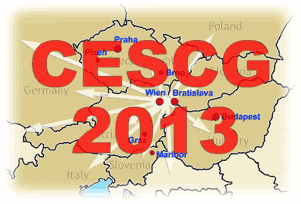
April 28th - 30th, 2013, in Smolenice, Slovakia
We received a large number of
submissions in reply to the Call for Participation of CESCG 2013.
Thus, we are proud to publish the preliminary program of
CESCG 2013.
Unfortunately, we were not able to provide presentation slots to all submissions,
but we have tried to make a fair selection. All papers will be published in the proceedings, however only
students with full presentation slots will be giving a 20 minutes presentation. Students without a
presentation slot should prepare a poster and present their in the poster session.
Please have a look at the list of submissions below and
send us as soon as possible the information still missing in the table (names, talk titles).
To prepare the successful preparation of printed
proceedings and web proceedings for the seminar, we want to remind
the participants about how to proceed in preparing their
contributions. The detailed timetable can be found in the Call for Participation.
Please note that this year there were again some changes to the LaTEX template,
as well as new instructions for providing images, so please review them carefully!
|
A Note to Participants
|
|
A Note to Participants |
Participants are required to upload a zipped
version of their submission (including possible supplementary material like additional images,
movies, ..., for reviewing) via our submission web page
by February 18, 2013, 23:59 CET at the latest.
Note that also this year we do not require an anonymous version.
The material will then be distributed for reviewing.
Reviews will be sent to the authors by March 11, 2013.
Final submissions must be uploaded by April 01, 2013, 23:59 CET
at the latest. Submissions which are uploaded after this deadline cannot be published in the
printed version of CESCG 2013 proceedings. As the HTML version
of the proceedings will be prepared in parallel with their printed
version, the HTML files have to be here by the same deadline as well.
Please read the upload instructions which are available at our
submission web page
carefully, such that we have no problems to include all the
contributions in the proceedings. Please recall that only
those contributions are included in any form of seminar proceedings
that conform to the "Guidelines for Authors" as specified at
http://www.cescg.org/guidelines/!
Please note that the templates have been updated for this year. Please use the latest version.
Please also make sure that all participants of CESCG 2013, esp. the
speakers and supervisors, do register as early as possible
via the registration page!
|
|
|
Preliminary Seminar Schedule
|
|
Preliminary Seminar Schedule |
The seminar schedule is again divided into three days. We have two invited
talks sessions, six paper sessions, coffee breaks and lunch and again very
popular social programs.
|
|
|
Invited Talks
|
|
Invited Talks |
The organizers of CESCG 2013
are proud to announce the invited talks to be held at the
seminar:
| Invited Speaker |
Title and Abstract |
Oliver BIMBER,
Austria | Shedding Light on Light Fields Images play an essential role in our life. Photography and television are technologies that influenced generations like not many other technologies did. Both would be unimaginable without images. Advanced imaging systems and image processing methods are today fundamental to many professions. Medical imaging is certainly a good example. And if nothing else, images are also the final outcome of every visualization algorithm.
Digital images are two-dimensional matrixes of pixels. Cameras are based on this notion: Even though 3D scene points emit varying light rays in different directions, the lens and the sensor of cameras integrate them to a single pixel. By doing this for all imaged scene points, we end up with nothing more than a 2D image -- having lost most of the scene information. Displays are based on this notion: Pixels of raster-displayed images emit (more or less) the same amount of light in all directions -- giving us nothing more than a 2D image. Visualization and image processing algorithms are based on this notion: They map complex (possibly multidimensional) data to 2D images and vice versa.
What if the notion of images would change once and forever? What if instead of capturing, storing, processing and displaying only a single color per pixel, each pixel would consist of individual colors for each emitting direction? Images would no longer be two-dimensional matrices but four-dimensional ones (storing spatial information in two dimensions, and directional information in the other two dimensions). This is called a light field.
Light fields have the potential to radically change everything that we relate to images -- from photography, over displays to image processing and analysis, and possibly even visualization. While first light-fields display prototypes have already been introduced in scientific communities and first light-field cameras are already commercially available, many unsolved challenges remain in the processing of light fields. While common digital images store mega-bytes of data, corresponding light fields might require gigabytes. While spatial consistency is a requirement for regular image processing, directional consistency has to be ensured in addition for light-field processing. In this talk, I will shed some light on light fields and light-field processing basics with applications to imaging and visualization. I invite the audience to think about what the impact for computer vision, image processing and analysis, or visualization could be if images evolve to light fields, raster display evolve to light-field displays, and digital cameras evolve to light-field cameras.
Bibliographical DetailsOliver Bimber became head of the Institute of Computer Graphics at Johannes Kepler University Linz in October 2009. From 2003-2010 he served as a Junior Professor of Augmented Reality at the Media System Science Department of Bauhaus-University Weimar. He received a Ph.D. (2002) in Engineering from Darmstadt University of Technology, Germany, and a Habilitation degree (2007) in Computer Science (Informatik) at Munich University of Technology. From 2001 to 2002 Bimber worked as a senior researcher at the Fraunhofer Center for Research in Computer Graphics in Providence, RI/USA, and from 1998 to 2001 he was a scientist at the Fraunhofer Institute for Computer Graphics in Rostock, Germany.
Bimber co-authored the book "Displays: Fundamentals and Applications" (2011) with Rolf R. Hainich and the book "Spatial Augmented Reality" (2005) with Ramesh Raskar (MIT). Since 2005 he serves on the editorial board of the IEEE Computer Magazine. The VIOSO GmbH was founded in his group in 2005. He and his students received several awards for their research and inventions, and have won scientific competitions, such as the ACM Siggraph Student Research Competition (1st place 2006 and 2008, 2nd place 2009 and 2011), and the ACM Student Research Competition Grand Final (2006) that was presented together with the Turing award. | Jiří BITTNER,
Czech Republic | Visibly Difficult Visibility Solving visibility is important for many computer graphics algorithms and often visibility is actually a bottleneck of the whole computation.
I will discuss typical visibility problems and their selected solutions targeting different application domains.
This will include potentially visible sets, real-time occlusion culling, shadow computation, and recent trends in ray casting based visibility computation. Bibliographical DetailsJiří Bittner is an assistant professor at the Faculty of Electrical Engineering of the Czech Technical University in Prague. He received his Ph.D. in 2003 at the same institute. His research interests include visibility computations, real-time rendering, spatial data structures, and global illumination. He has also participated in several commercial projects dealing with real-time rendering of complex scenes. |
|
|
|
Preliminary Program
|
|
Preliminary Program | |
In the following we present all the posters announced for CESCG 2013.
In case of missing information (no name or title yet, etc.) we ask
the concerning group to send the missing data as soon as possible.
| Country | University | Author | Title | | Austria | Graz | Georg Reinisch | Panoramic Mapping on Mobile Phone GPUs |
| Vienna (VRVis) | Iman Tahvili | Enhanced Multi-resolution Peripheral Artery Tracking in CTA data |
| Michael May | Design and Implementation of a Shader Infrastructure and Abstraction Layer |
| Vienna (VUT) | Christoph Weinzierl-Heigl | Efficient VAL-based Real-Time Global Illumination |
| Bosnia-Hercegovina | Sarajevo (IUS) | Irvin Stevic | Learning OpenGL and shader programming |
| Sarajevo (SSST) | Senad Bahor | HTML5/WebGL vs Flash in 3D Visualisation |
| Sarajevo (UNI) | Merisa Huseinovic | Interactive animated storytelling in presenting intangible cultural heritage |
| Czech Republic | Brno (VUT) | Alexander Páldy | Advanced Markers for Augmented Reality |
| Martin Simon | Support of acquisition of recognition of mushroom images |
| Brno (MU) | Martin Bezdeka | String Sculptures Editor in Virtual Environment |
| Matus Kotry | Detection and visualisation of molecular surfaces on large macromolecules |
| Prague (CVUT) | Petr Egert | Efficient GPU-based Decompression of BTF Data Compressed using Multi-Level Vector Quantization |
| Germany | Bonn | Vitalis Wiens | Volumetric Segmentation of Complex Bone Structures from Medical Imaging Data Using Reeb Graphs |
| Hungary | Budapest | Zsolt Márta | Stabilized Backward Diffusion for Partial Volume Correction |
| Márton Vaitkus | Grayscale and Color Image Segmentation using Computational Topology |
| Norway | Bergen | Morten Bendiksen | Rapid Modeling of Geology |
| Poland | Szczecin | Rafał Krochmal | Real time prototyping of physical lighting based on goniometric light sources |
| Tomasz Sergej | Perceptual Evaluation of Demosaicing Techniques |
| Slovakia | Bratislava (UK) | Matej Kopernicky | 3D Scene Reconstruction Using Partial RGB+Depth Maps |
| Stanislav Fecko | Real-time Rendering of Parametric Skin Model |
| Csaba Bolyós | Scarlet - Real Time Mobile Augmented Reality Library |
| Bratislava (STU) | Marek Jakab | Planar Object Recognition Using Local Descriptor Based On Histogram Of Intensity Patches |
| Slovenia | Maribor | Danijel Žlaus | Towards O(N^1.5) estimation of Quasi-Distance Transform |
| United Kingdom | Manchester | Anna Mölder | Methods to improve the understanding of microscopic embryo data sets using image analysis |
|
|
Maintained by .
Last update on 1. Jan 70.
Comments to (at) cg.tuwien.ac.at. |
 |
|
|